First batch · LSJZ1-70
Civilian Residence at 98, Haier Alley
Civilian Residence at 98, Haier Alley (孩儿巷98号民居建筑) is a Qing-era traditional house in Hangzhou, China, built in the qing dynasty. The city declared it a protected historic building on 24 May 2004, as number LSJZ1-70 in the first batch of 75.
On this page
What the listing says
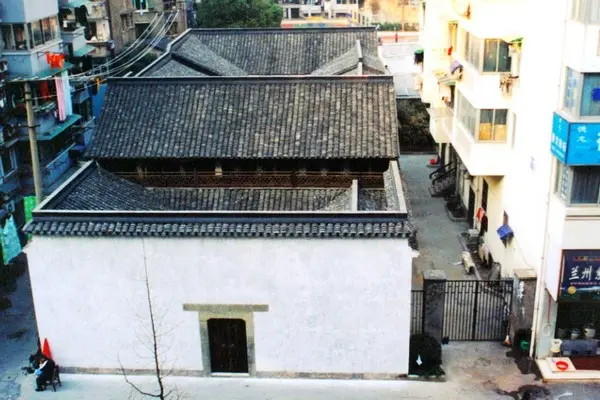
The English Wikipedia list gives no description for this building, only its name and number; the facts below come from the Chinese sources.
Listed as a Hangzhou municipal protected cultural relics site in 2013.
The house stands on the north side of Haier Alley in Wulin subdistrict, Gongshu District. It is a timber courtyard house in the local Hangzhou style, built around the 1850s. Local tradition calls it the house of the Song poet Lu You, who stayed near Haier Alley in 1186 and wrote of hearing spring rain in a small upstairs room; the building itself is centuries younger, and the tradition is unproven.
Around 2000 it was due to be demolished for a school playground. A resident, Qian Xiyao, refused to leave and campaigned for years; the house was saved, restored between 2003 and 2005, and opened in 2006 as the Lu You Memorial Hall. Of four courtyards in depth, two survive after road widening, on 956.7 square metres. Its upper rear windows still use translucent oyster shell instead of glass, now rare in Hangzhou.
Key facts
| Fact | Detail |
|---|---|
| List number | LSJZ1-70 |
| Chinese name | 孩儿巷98号民居建筑 |
| Batch | First batch, announced 24 May 2004 |
| Built | Qing dynasty |
| Listed address | 孩儿巷98号 |
| Type | Qing dynasty houses |
Where it fits
Traditional houses of the Qing dynasty (1644–1912) on Hangzhou's list are mostly timber-framed courtyard houses of one or two storeys, closed to the street by walls and gateways. They stand in the lanes of the old city, along the canal and the Qiantang River at Xixing and Changhe, and in the towns and villages of Xiaoshan and Yuhang. All the qing dynasty houses on the list.
It belongs to the first batch, announced on 24 May 2004: 75 buildings, from Republican-era villas around West Lake to lane houses, temples and churches in the old city.
What the listing protects
A listed building may not be altered, moved or demolished without approval. Under the regulations in force since 1 October 2013, each listed building has a protection plan and a sign put up by the city, and falls into one of three protection categories, from keeping its main exterior features to keeping its exterior, plan, structure and details.
Its owner, or for a state-owned building its user, is responsible for upkeep and repairs, and a repair plan must be approved first. The listing does not open a building to the public: most listed buildings are still homes, offices, schools or shops.
Next to it on the list
- The Contemporary Building of Huimin Road: LSJZ1-69, republican era (1912–1949)
- The Former Residence of Du Yuesheng: LSJZ1-71, between 1911 and 1949
Sources and licence
- Chinese name, period, address and remarks: Chinese Wikipedia, 杭州市历史建筑 and the building's own article, CC BY-SA 4.0.
- Listing: Hangzhou municipal government notice 杭政办函〔2004〕154号 of 24 May 2004.
- Photo: Laohangzhou, CC BY-SA 3.0, from Wikimedia Commons. Photos credited to "hangzhoumemory" or "Laohangzhou" were uploaded by the former heritage portal; Hangzhou Memory is not connected with it.
- The text of this page is available under CC BY-SA 4.0.
Frequently asked questions
Where is Civilian Residence at 98, Haier Alley?
The city's list gives its address as 孩儿巷98号, Hangzhou. Chinese map apps and taxi drivers will recognise the address in Chinese.
When was Civilian Residence at 98, Haier Alley declared a historic building?
On 24 May 2004, as number LSJZ1-70 in the first batch of 75 historic buildings announced by the Hangzhou municipal government (杭政办函〔2004〕154号).
What does LSJZ1-70 mean?
It is the building's number on the city's list. LSJZ abbreviates lishi jianzhu, "historic building"; 1 is the batch and 70 its place in that batch.
Keep reading
- The First Batch of Hangzhou Historic Buildings (2004)The first batch of Hangzhou historic buildings: 75 buildings declared on 24 May 2004, each with its number, period, address and a page of its own.
- Qing Dynasty Houses in Hangzhou: The Listed Courtyard HomesQing dynasty houses in Hangzhou on the city's list: 49 timber courtyard homes in the old city, at Xixing and Changhe and in Xiaoshan and Yuhang villages.
- Hangzhou Historic Building Regulations: What a Listing MeansHangzhou historic building regulations in plain English: what can be listed, the three protection categories, owners' duties, fines and the 2023 city-wide law.
Hangzhou Memory is an independent reference site. It is not affiliated with the Hangzhou municipal government, its heritage or real estate bureaus, or any previous operator of this domain.