Fifth batch · LSJZ5-19
Buildings at 99 and 100, Mituosi Road
Buildings at 99 and 100, Mituosi Road (弥陀寺路99、100号建筑) is a religious building in Hangzhou, China, built in the late Qing dynasty. The city declared it a protected historic building on 22 March 2010, as number LSJZ5-19 in the fifth batch of 43.
On this page
What the listing says
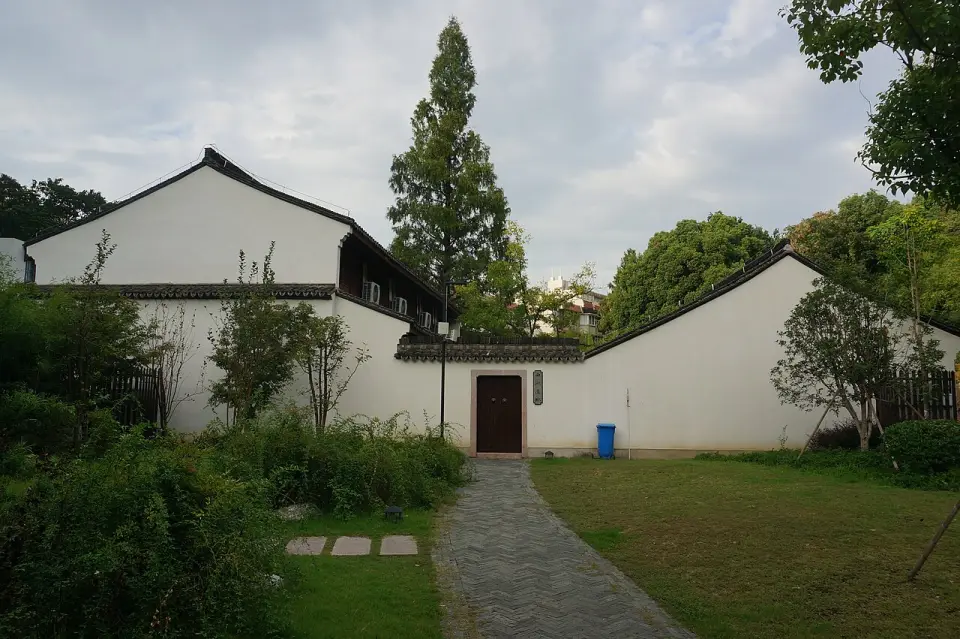
The city's description, as summarised on English Wikipedia: Constructed in the late Qing Dynasty, it is a religious building in timber structure, formerly the auxiliary buildings of Mituo Temple.
Originally ancillary buildings of Mituo Temple.
Mituo Temple stands below Xiaohuoshan, also called Mituo Hill, in Songmuchang, Xihu District, now inside Mituo Temple Park. It was a Pure Land Buddhist temple; the Chinese Wikipedia article dates its founding to 1878, while the city's listing gives the 1850s. In the twentieth century it served as a school, a factory and housing, and after restoration it reopened in July 2016 as a cultural park rather than a working temple. Its best-known feature is the Amitabha Sutra carved across a rock face: 24 metres long and about 5 metres high, 2,194 characters of about 15 cm each, written by Shen Shandeng. It is the largest cliff inscription surviving in Hangzhou.
Key facts
| Fact | Detail |
|---|---|
| List number | LSJZ5-19 |
| Chinese name | 弥陀寺路99、100号建筑 |
| Batch | Fifth batch, announced 22 March 2010 |
| Built | Late Qing dynasty |
| Listed address | 弥陀寺路99、100号 |
| Type | Temples and churches |
Where it fits
Hangzhou has been a centre of Buddhism for more than a thousand years, and the list includes former temple sites, nunneries and halls as well as a Protestant church of the 1920s. Many of these buildings lost their religious use in the twentieth century and served as schools, factories or homes; the listing protects what survives of their halls and courtyards. All the temples and churches on the list.
It belongs to the fifth batch, announced on 22 March 2010: 43 buildings, including Qing lanes of the old city, factories and warehouses of the 1950s to 1980s, and rural houses in Xiaoshan.
What the listing protects
A listed building may not be altered, moved or demolished without approval. Under the regulations in force since 1 October 2013, each listed building has a protection plan and a sign put up by the city, and falls into one of three protection categories, from keeping its main exterior features to keeping its exterior, plan, structure and details.
Its owner, or for a state-owned building its user, is responsible for upkeep and repairs, and a repair plan must be approved first. The listing does not open a building to the public: most listed buildings are still homes, offices, schools or shops.
Next to it on the list
- Building #1 of Research Buildings at Zhejiang Gongshang University (149, Jiaogong Road): LSJZ5-18, 1950s
- Buildings at 15, 18, 20, and 28, Liushuiqiao Alley: LSJZ5-20, early republic of china
Sources and licence
- Description: adapted from the English Wikipedia article List of fifth batch of declared historic buildings in Hangzhou, CC BY-SA 4.0.
- Chinese name, period, address and remarks: Chinese Wikipedia, 杭州市历史建筑 and the building's own article, CC BY-SA 4.0.
- Listing: Hangzhou municipal government notice 杭政函〔2010〕85号 of 22 March 2010.
- Photo: 猫猫的日记本, CC BY-SA 4.0, from Wikimedia Commons. Photos credited to "hangzhoumemory" or "Laohangzhou" were uploaded by the former heritage portal; Hangzhou Memory is not connected with it.
- The text of this page is available under CC BY-SA 4.0.
Frequently asked questions
Where is Buildings at 99 and 100, Mituosi Road?
The city's list gives its address as 弥陀寺路99、100号, Hangzhou. Chinese map apps and taxi drivers will recognise the address in Chinese.
When was Buildings at 99 and 100, Mituosi Road declared a historic building?
On 22 March 2010, as number LSJZ5-19 in the fifth batch of 43 historic buildings announced by the Hangzhou municipal government (杭政函〔2010〕85号).
What does LSJZ5-19 mean?
It is the building's number on the city's list. LSJZ abbreviates lishi jianzhu, "historic building"; 5 is the batch and 19 its place in that batch.
Keep reading
- The Fifth Batch of Hangzhou Historic Buildings (2010)The fifth batch of Hangzhou historic buildings: 43 buildings declared on 22 March 2010, each with its number, period, address and a page of its own.
- Hangzhou Historic Temples and Churches on the City's ListHangzhou historic temples and churches on the city's list: 13 temples, temple sites, nunneries and Sichengtang Church, with what survives and what is open.
- Hangzhou Historic Building Regulations: What a Listing MeansHangzhou historic building regulations in plain English: what can be listed, the three protection categories, owners' duties, fines and the 2023 city-wide law.
Hangzhou Memory is an independent reference site. It is not affiliated with the Hangzhou municipal government, its heritage or real estate bureaus, or any previous operator of this domain.